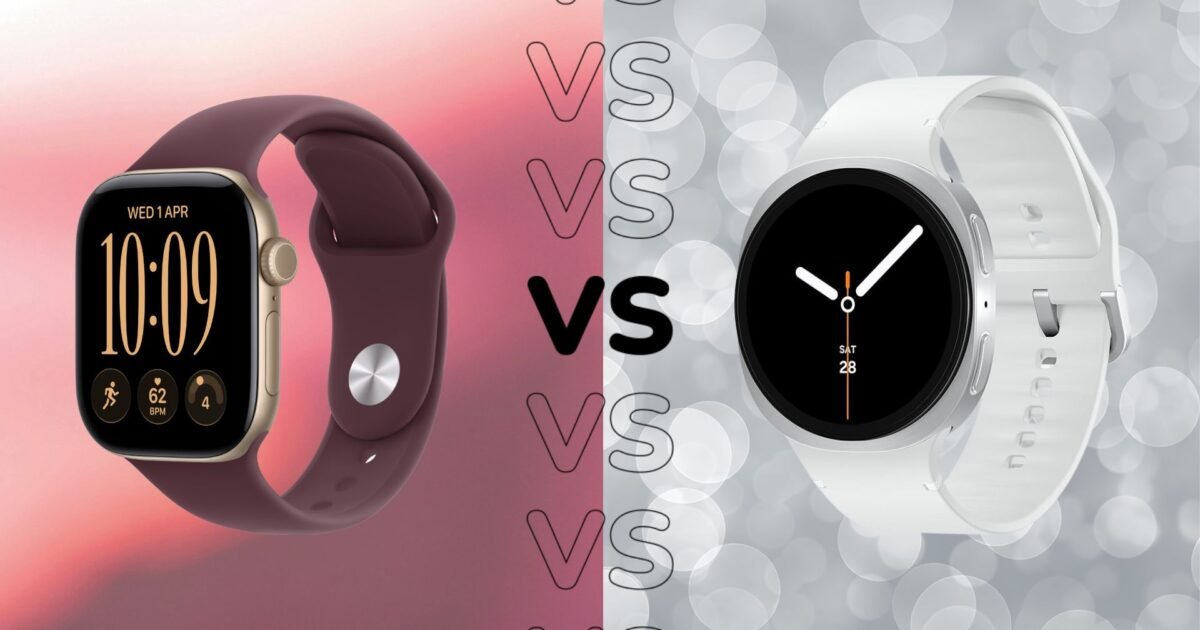
Both of this year’s flagship smartwatches are officially out in the wild now, and the Apple Watch Series 12 vs Galaxy Watch 9 debate has real, confirmed specs behind it for the first time this generation. Apple’s Series 12 launched September 9 alongside the iPhone 18 Pro lineup, while Samsung’s Galaxy Watch 9 has been shipping with a confirmed Qualcomm chip verified back at MWC 2026. Here’s how they actually compare.
Price and Availability
- Apple Watch Series 12: Starts at $399
- Galaxy Watch 9: Starts at $379.99 for the Bluetooth model
The two are priced almost identically, meaning the decision here really does come down to ecosystem and features rather than budget.
Design Philosophy: Square vs Round
This one hasn’t changed in years, and it’s not changing now. The Series 12 keeps Apple’s familiar rectangular case design, refined since 2015, while the Galaxy Watch 9 sticks with Samsung’s “squircle” shape introduced with the Watch 7, offering a more traditional, rounded watch face feel. Neither company is taking design risks this generation, both are clearly betting that their existing look already works for their base.
What’s Actually New on the Apple Watch Series 12
The Series 12’s headline changes are almost entirely under the hood, powered by Apple’s new S11 chip. The biggest shift is a redesigned sensor stack, new optical and electrical heart sensors with larger green LEDs now read heart rate every five seconds throughout the day and HRV every five minutes, split into Recovery HRV and overall HRV. That data feeds a brand new Readiness app, giving users a daily 0 to 10 recovery score along with four personalized recommendations.
The Series 12 also introduces Audio Intelligence, a suite of features running on the S11 chip’s Secure Exclave, including Sound Recognition alerts for sirens, alarms, doorbells, and even baby cries, a Live Rewind feature that transcribes the last 15 seconds of nearby conversation as text, Siri Recap summaries, and Shazam integration. Apple’s own materials note that Sound Recognition specifically is still rolling out and expected to be fully available “late 2026.” The watch also gains a depth gauge rated to 6 meters and a water temperature sensor.
What’s Actually New on the Galaxy Watch 9
Samsung’s headline upgrade is the confirmed Snapdragon Wear Elite chip, verified directly by Qualcomm at MWC 2026, a genuine step up from previous Galaxy Watch generations. It’s paired with meaningfully larger batteries across both sizes, 390mAh on the 40mm model and 445mAh on the 44mm model, both notable increases over the Watch 8. Samsung’s own efficiency claims suggest multi-day battery life could become realistic on a mainline Galaxy Watch for the first time, though independent third-party testing hasn’t confirmed that yet.
Display sizes are confirmed at 1.34 inches (40mm) and 1.47 inches (44mm), with both sizes now upgraded to sapphire crystal glass, a genuine durability improvement over the Watch 8’s standard glass. Samsung’s full health suite, real-time heart tracking, body composition analysis, and sleep coaching, remains available today across the lineup.
The Ecosystem Question That Actually Decides This
Here’s the detail that matters more than almost any spec on either sheet. The Galaxy Watch 9 runs Wear OS and does not work with iPhones at all, full stop. The Apple Watch Series 12 runs watchOS and requires an iPhone, it has no Android compatibility whatsoever. That single fact eliminates one option immediately for the vast majority of buyers, no comparison of sensors or chips matters if you’re not already inside the matching phone ecosystem.
So, Which One Should You Actually Buy?
If you’re an iPhone user, the Series 12’s new health sensor stack and Audio Intelligence features make it Apple’s most capable mainline watch yet, arguably the biggest software-driven health upgrade the Series line has gotten in a few years. If you’re an Android user, the Galaxy Watch 9’s confirmed Snapdragon Wear Elite chip and larger batteries represent a genuine, verified step up from the Watch 8, at a price roughly $20 cheaper than Apple’s equivalent.
For the small slice of buyers genuinely choosing between ecosystems rather than locked into one already, the honest read is that both companies delivered real upgrades this year rather than a token refresh, Apple leaning into health sensing and ambient audio intelligence, Samsung leaning into raw hardware performance and battery life.
The Bottom Line
The Apple Watch Series 12 vs Galaxy Watch 9 comparison is closer to a genuine ecosystem decision than a clear spec sheet win for either side this year. Both companies made real, substantive upgrades rather than cosmetic ones, which makes 2026 a genuinely strong year to be shopping for a flagship smartwatch, regardless of which phone is already in your pocket.
You can check full specs and current pricing directly on Apple’s official Watch page and Samsung’s official Galaxy Watch page.
For more on what else launched alongside the Series 12 this month, check out our full breakdown of the iPhone Duo and iPhone 18 Pro features.