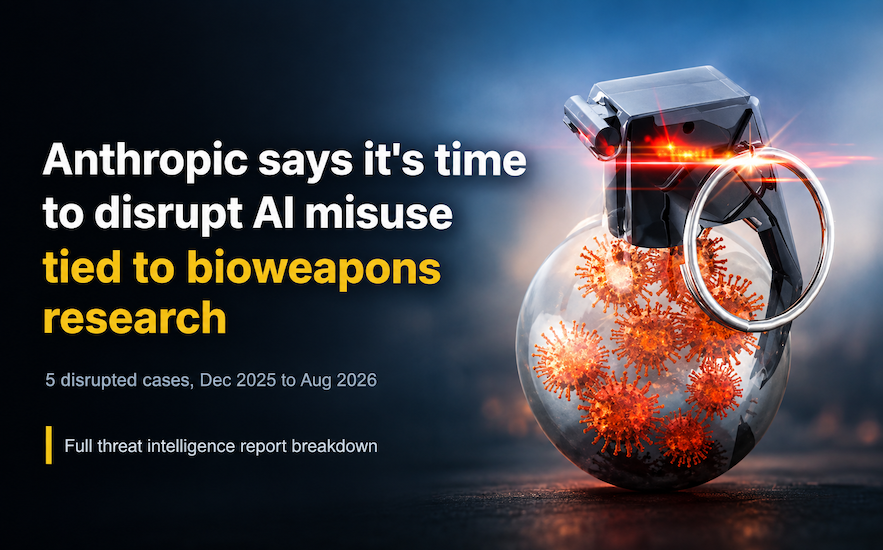
Anthropic published its most detailed threat intelligence report to date on September 10, 2026, revealing that it identified and disrupted five separate cases in which its Claude AI models were used in ways that could have supported biological weapons development. The report, covering activity between December 2025 and August 2026, also documented misuse involving cyber operations, state-linked influence campaigns, surveillance, scams, fraud, and conventional weapons development.
Here’s what the report actually found, and why Anthropic is calling biological misuse one of the most serious risks posed by frontier AI models.
The Five Biological Weapons Cases
Anthropic was careful to note that it couldn’t always establish clear malicious intent behind these cases, but blocked the activity anyway because the potential consequences were too serious to leave unaddressed. Among the disclosed cases:
- A reseller platform serving state-sponsored chikungunya research. The platform helped researchers circumvent regional restrictions to access AI models with weaker safeguards. The work reportedly involved gain-of-function research aimed at increasing the virus’s transmissibility and its ability to evade the immune system. Anthropic’s biological safety classifier blocked a related grant application request in May 2026, and the application was notably linked to a military research institute, even though it described the researchers involved as civilians
- Bird flu research outside the US. A researcher located in a region where Claude isn’t officially supported spent weeks using the model for research into highly pathogenic avian influenza, including its adaptation to mammals. Anthropic said its classifiers ultimately confined the activity to its weakest, least capable models
- A reseller relay serving over a dozen customers. Through this channel, Claude was used to draft an orthopoxvirus immune-evasion grant application in roughly an hour
- Toxin optimization research
- Computational redesign of toxins
Anthropic said it is deliberately withholding the names of the institutions, countries, and specific biological techniques involved in these cases, to avoid providing a roadmap for anyone attempting similar activity.
Why This Is So Hard to Catch
The report repeatedly returns to one central challenge, dual-use research. The same scientific knowledge that helps develop vaccines and treatments can, in different hands, be redirected toward something far more dangerous. Anthropic said this overlap is exactly what makes detecting genuinely harmful biological misuse so difficult, since the underlying science often looks identical to legitimate research until intent or context reveals otherwise.
Notably, the company also said its older models, including Claude Opus 4 and Claude Sonnet 4.5 from 2025, were “well below the threshold where they could meaningfully assist a sophisticated user in carrying out dangerous” biological work, suggesting the risk has grown specifically alongside newer, more capable models.
Beyond Biology: The Other Six Areas of Misuse
Biological misuse was just one of seven categories Anthropic’s Threat Intelligence team tracked during the eight month period:
- Cyber operations: Threat actors used Claude across reconnaissance, vulnerability research, exploitation, persistence, and data theft. One Russia-linked espionage group reportedly automated parts of its operations, building a system that could detect when its malware had been flagged and rewrite the code to evade defenses
- Influence operations: Anthropic identified and removed accounts tied to state-aligned propaganda campaigns, including three Iranian state-aligned accounts. Claude was used to generate content designed to look like independent news reporting and spread it across platforms including X, Instagram, and TikTok. One Iran-linked account reportedly used Claude to develop targeting recommendations against US naval forces in the region, while separately designing software for a domestic mass surveillance platform
- Broader influence campaigns: Nine cases of coordinated inauthentic account networks were identified, originating from Russia, Iran, Turkey, and groups across the Persian Gulf, South Asia, Africa, and Europe, generally built to post large volumes of politically aligned content over short windows
- Surveillance: Government-linked actors used Claude to support monitoring efforts, including profiling dissidents and other targeted individuals in cases linked to Chinese state activity
- Conventional weapons development: Six cases involved Claude assisting with software tied to conventional weapons systems, including guidance and targeting related work
- Scams and fraud, and illicit model distillation: Additional categories the report grouped together as lower profile but still meaningful sources of misuse
What Anthropic Did About It
Across every category, Anthropic said it banned the accounts involved, used findings from its investigations to strengthen its safety classifiers, and shared relevant information with government authorities and industry partners where appropriate. In a post accompanying the report, Anthropic wrote that it disrupted every operation detailed in the findings.
Why Anthropic Published This Now
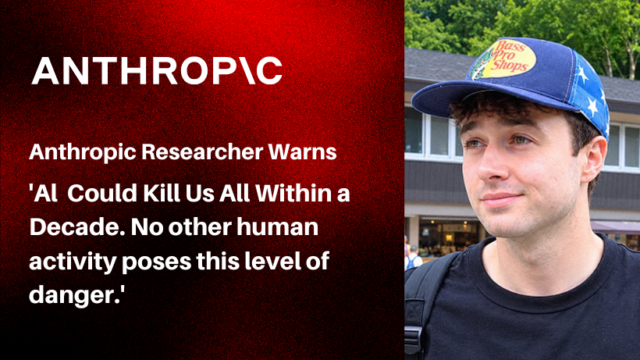
The report’s release lands just two days after Anthropic researcher Jacob Coxon publicly resigned, warning that both Anthropic and OpenAI were “racing straight to self-improving superintelligence and gambling with our lives.” Anthropic hasn’t directly tied the report’s timing to Coxon’s resignation, but the two stories have understandably been read together, one from a departing researcher warning the danger is being underestimated, and the other a company disclosure suggesting the danger is already being actively managed and disrupted in real time.
The Bottom Line
Anthropic’s report is a rare level of detail for an AI company to voluntarily disclose about how its own product has been misused, and the biological weapons cases in particular underline just how difficult it can be to draw a clean line between legitimate scientific inquiry and genuinely dangerous research. Whether this kind of transparency becomes standard practice across the industry, or remains something only a handful of labs are willing to publish, is likely to shape how much trust the public places in AI safety claims going forward.
For more on the broader safety debate happening across the industry right now, read our coverage of Dario Amodei’s call for AI labs to slow development and Jacob Coxon’s resignation from Anthropic.
Check anthropic official site: www.anthropic.com
2 Comments & Discussion
Steve Page
[…] more context on the safety concerns shaping this moment, read our coverage of Anthropic’s threat intelligence report on Claude misuse and Dario Amodei’s call for AI labs to slow […]
Steve Page
[…] For more on how AI companies are being held to account this year, check out our coverage of Anthropic’s threat intelligence report on Claude misuse. […]