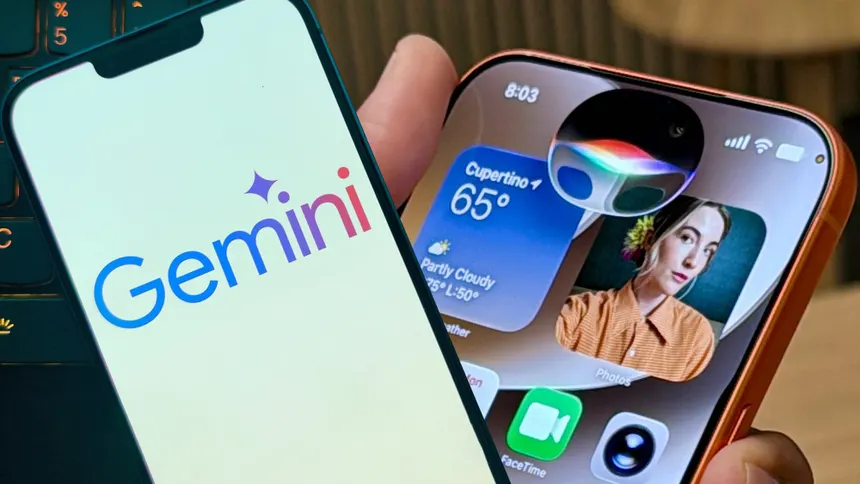
After a partnership first confirmed back in January, a beta rollout that started in spring, and years of promises stretching back to 2024, Gemini-powered Siri has now fully arrived with iOS 27, launching alongside the iPhone 18 Pro, Pro Max, and iPhone Duo earlier this month. The assistant you’ve been talking to for over a decade now has a genuinely different brain behind it.
What Actually Changed
Siri still looks and sounds like Siri on the surface, same voice, same wake phrase, same place in the interface. But the reasoning behind more complex requests is now handled by a custom Gemini model built specifically for Apple, running through Apple’s Private Cloud Compute infrastructure rather than Apple’s own foundation models alone.
The rollout happened in two distinct phases. Phase one arrived quietly with iOS 26.4 and 26.5 earlier this year, giving Siri better context awareness, the ability to summarize what’s on your screen, and smarter handling of everyday requests. Phase two, the full conversational overhaul, launched with iOS 27 this September, bringing a rebuilt, standalone Siri app with a chat-style interface, support for chaining up to 10 cross-app actions from a single voice command, and access to personal context like emails, messages, files, and photos to actually complete multi-step tasks rather than just answer questions.
The Deal Behind the Curtain
According to reporting from Bloomberg’s Mark Gurman, Apple is paying Google roughly $1 billion per year for access to a custom Gemini model built specifically to power Siri’s cloud-based reasoning, reportedly running around 1.2 trillion parameters internally referred to as Apple Foundation Models v10. Apple pairs that cloud capability with its own smaller, on-device models for privacy-sensitive tasks, routing only the heavier, world-knowledge requests to the Gemini-powered cloud layer.
It’s a genuinely unusual arrangement for two companies that compete directly in nearly every other part of the smartphone and AI landscape, Apple effectively outsourcing the hardest part of its AI assistant to its biggest software rival, while keeping the on-device, privacy-preserving layer entirely its own.
Apple’s Privacy Pitch
Apple has been notably deliberate about how it frames the privacy side of this deal. According to Apple’s own explanation of the architecture, queries routed to Gemini are de-identified before they ever reach Google’s servers, meaning Google reportedly cannot see your name, contacts, location, or other identifying account details, and cannot use your Siri interactions to train future Gemini models. The de-identified request goes out, gets processed, and the response routes back through Apple’s own infrastructure to your device.
Whether that architecture holds up to independent scrutiny over time remains to be seen, but it’s clearly the central promise Apple is making to justify handing its most personal assistant’s reasoning over to a competitor’s model.
You’re Not Locked Into Gemini Either
One of the more interesting side effects of this overhaul is a new Extensions system in iOS 27, letting users choose a different default AI model entirely if they’d rather not use Gemini-powered Siri at all. Both Claude and ChatGPT are supported as alternative default assistants, meaning the Gemini partnership isn’t so much a replacement as it is Apple’s new default choice, one users can swap out if they prefer a different model handling their requests.
Why This Matters Beyond Apple
This deal represents one of the more consequential AI partnerships to land in years, not because of the technology itself, but because of what it signals about how even the biggest tech companies are now willing to lean on rivals rather than go it entirely alone. Apple spent years publicly insisting it could build its own competitive AI assistant in-house. The Gemini partnership is, in effect, a quiet admission that catching up on its own timeline wasn’t realistic, and that shipping something genuinely competitive mattered more than building it alone.
The Bottom Line
Gemini-powered Siri is no longer a rumor, a beta feature, or a future promise, it’s the assistant running on iPhones people are unboxing right now. Whether it closes the gap with ChatGPT and Google’s own Gemini app in daily use will likely take a few months of real-world testing to settle, but the architecture, the privacy framing, and the choice to let users opt for a different model entirely are all now live and in people’s hands.
You can read more about the underlying partnership directly from Google’s own announcement.
For more on everything else that shipped alongside this update, check out our full breakdown of the iPhone Duo and iPhone 18 Pro features.