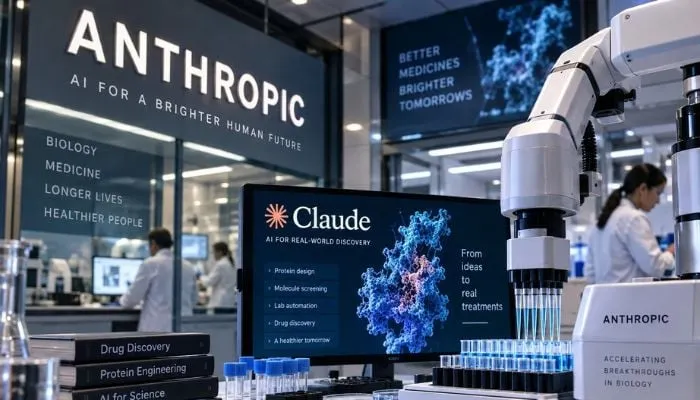
Anthropic has spent its entire existence as a software company. That just quietly changed. According to Reuters, Anthropic has established its own wet lab, a physical facility for hands-on biological experiments, in the San Francisco Bay Area, marking the company’s first real step from AI theory into actual laboratory work.
What Anthropic Confirmed
Eric Kauderer-Abrams, Anthropic’s Head of Life Sciences, confirmed the lab’s existence directly to Reuters. “We believe that to do biology, the final test is still and will be for a while in real lab work,” he said. “We absolutely are doing that today, and I would describe our approach as being typical of what you would see in most biotech companies, where there’s some amount of that that we’re doing in our own facilities and some amount of that that we’re working with external partners on.”
A wet lab, for anyone unfamiliar with the term, is simply a facility equipped to handle actual biological materials, chemicals, samples, live cultures, rather than the purely computer-based, “in silico” research Anthropic has relied on until now. Kauderer-Abrams didn’t specify exactly what Anthropic is working on inside it, and an Anthropic spokesperson later told Reuters the lab isn’t specifically, or perhaps only, for drug discovery, declining to elaborate further.
The Bigger Bet: Claude Running the Equipment
The more striking detail buried in the reporting is what Anthropic is reportedly testing inside the lab. Sources told Reuters that one of the things being explored is having Claude itself control robotic lab equipment to carry out scientific experiments, with human oversight remaining part of the process for safety. Kauderer-Abrams was careful to frame this as very early stage work. “We’re in the very early innings of using AI to automate the execution of lab work,” he said.
If that effort matures, it would mark a genuine shift, an AI model moving from advising on biology to physically directing the instruments that conduct biological experiments itself.
This Didn’t Come Out of Nowhere
The wet lab is the latest step in a build-out Anthropic has been quietly assembling over the past year. In June, the company launched Claude Science, a research workbench combining scientific databases and computational tools aimed at accelerating literature review and data analysis. In August, it introduced the Model Hardware Standard, a specification designed specifically to let AI agents communicate with and operate physical lab and manufacturing equipment. Anthropic also acquired biotech startup Coefficient Bio for roughly $400 million in stock, and added Novartis CEO Vas Narasimhan to its board.
Anthropic’s stated ambition, according to comments Kauderer-Abrams made at a San Francisco event back in June, is to pursue preclinical research into rare diseases and “undruggable” conditions, areas traditional pharmaceutical companies tend to skip because they’re unlikely to be financially profitable. The company has been explicit that it has no plans to become a traditional pharmaceutical company or run human clinical trials itself.
Why the Timing Is Raising Eyebrows
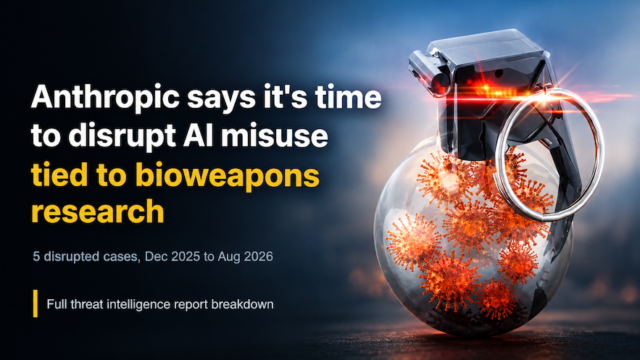
Here’s what makes this announcement land differently than it might have a few months ago. It comes just days after Anthropic published its own threat intelligence report disclosing that it had identified and disrupted five separate cases of Claude being misused in ways that could support biological weapons development, and just over a week after CEO Dario Amodei’s public essay calling on the entire AI industry to slow the pace of frontier development, citing serious risk concerns.
Reuters itself noted the awkward optics directly, pointing out that Anthropic, like other AI companies, still has a real trust problem with the public around biological risk, and that opening its own physical biology facility at this exact moment invites scrutiny it might not have drawn a year ago. Anthropic hasn’t publicly addressed that tension directly, but the juxtaposition, a company warning the world about AI-enabled bioweapons risk while simultaneously opening its own hands-on biology lab, is not lost on observers covering the story.
The Bottom Line
Anthropic’s wet lab is a genuinely significant expansion for a company that’s spent its history entirely in software, and the potential upside, faster research into diseases the traditional pharmaceutical industry has little financial incentive to pursue, is real. Whether the public reads this as a company matching its safety rhetoric with responsible, closely supervised science, or as a company whose actions are moving faster than its own stated caution can keep up with, will likely depend heavily on how transparent Anthropic chooses to be about what actually happens inside that lab going forward.
You can read more about Anthropic’s broader life sciences work directly on Anthropic’s official site.
For more context on the safety concerns shaping this moment, read our coverage of Anthropic’s threat intelligence report on Claude misuse and Dario Amodei’s call for AI labs to slow down.