Dyson makes vacuums, hair dryers, and air purifiers. Now it makes toothbrushes, and the one it just launched has a camera hidden inside the brush head. The Dyson CameraJet isn’t a gimmick dressed up as innovation, it’s a genuine attempt to solve a problem toothbrush makers have quietly ignored for decades, most people have no idea where they’re actually missing when they brush.
What the Dyson CameraJet Actually Does
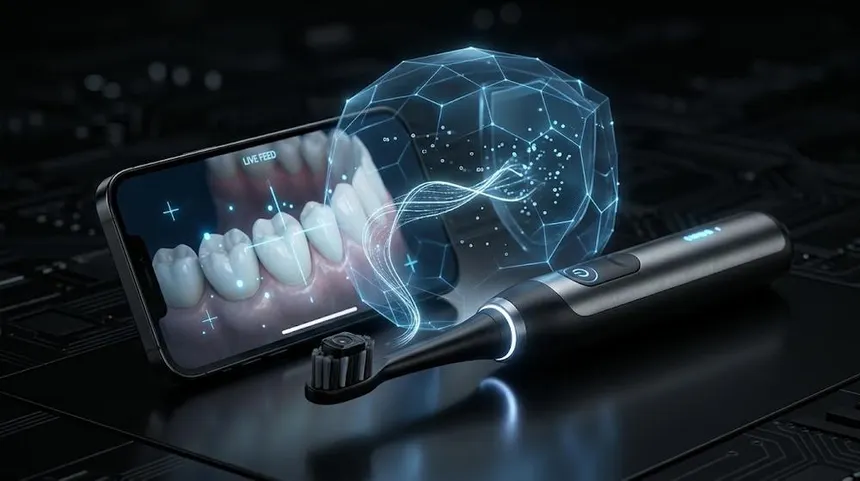
At the center of the CameraJet is a 100,000-pixel macro-lens camera built directly into the brush head, capturing 28 images every second as you brush. Dyson’s machine learning system, called Gap Optical Targeting, analyzes those images in real time to spot the gaps between your teeth where plaque tends to form and harden.
When the system detects a gap, it triggers a precise, cone-shaped burst of mouthrinse aimed directly at that spot, all within about 100 milliseconds. In practical terms, the toothbrush is flossing for you while you brush, without you needing to identify where the gaps actually are.
The Numbers Behind It
Dyson didn’t rush this out. The company says CameraJet is the result of six years of research and development, built using more than 470,000 dental images and 16 million lines of code, with 661 engineers working on the project. Dyson has also filed 38 patents connected to the device.
James Dyson, the company’s founder and chief engineer, has said the idea came from a personal frustration, he simply hates flossing, and found existing water flossers largely ineffective at actually reaching the spaces between teeth.
You Can Watch Your Own Mouth in Real Time
One of the more unusual features here is live viewing. Connected through the MyDyson app, users can literally watch footage from inside their own mouth while brushing, alongside guided cleaning, coverage mapping, and personalized feedback showing exactly which spots get missed most often.
If that raises an immediate privacy question, Dyson has an answer ready. The company says the camera is only active during live viewing or automatic jetting, and that images are never recorded or stored, either on the device or in the cloud.
Design Details Worth Knowing
- Price: $499.99 in the US, £420 in the UK
- Colors: Ceramic Pink and Ceramic Ultra Blue
- Included: CameraJet toothbrush, charging dock, travel case, Dyson toothpaste, and Dyson mouthrinse
- Brush motion: Sonic oscillation moving nearly 1,000 times per second, with dual-length bristles designed to hug tooth contours
- Jet design: A cone-shaped spray rather than the needle-like stream used by traditional water flossers, intended to cover a wider surface area while staying gentle on gums
- Anti-gravity tank: Engineered to keep delivering consistent jets whether the brush is held upright, angled, or horizontal, useful for reaching the back teeth
- Refill speed: The charging dock can refill the 12.5 milliliter mouthrinse tank in about three seconds
Is It Worth $500 for a Toothbrush?
That’s obviously the sticking point. $499 puts the CameraJet firmly in “serious investment” territory for an oral care product, and it’s not the kind of thing most people will buy on impulse. But the broader context is worth considering, oral disease affects an estimated 3.7 billion people globally, and there’s growing recognition of links between oral health and conditions like heart disease and Alzheimer’s. Most people also brush for around 45 seconds on average, well under the recommended two minutes, and no timer-based toothbrush has ever been able to tell you where you’re actually missing, only how long you’ve been going.
Early reaction has actually leaned positive rather than skeptical, with plenty of people online calling it a genuinely clever application of AI and machine learning to something ordinary, rather than another AI feature bolted onto a product that didn’t need it.
The Bottom Line
The Dyson CameraJet launched September 1, 2026, and it’s already becoming one of the most talked about gadgets of the month, not for novelty, but because the underlying idea genuinely holds up. Whether $499 is worth it will come down to how seriously you take your dental health, and whether watching your own mouth on your phone while you brush sounds useful or slightly unsettling. Either way, it’s a rare example of an AI powered gadget that solves a problem people actually have.
For more of this month’s most talked about hardware, check out our coverage of the iPhone Duo’s in-display camera and full feature breakdown.