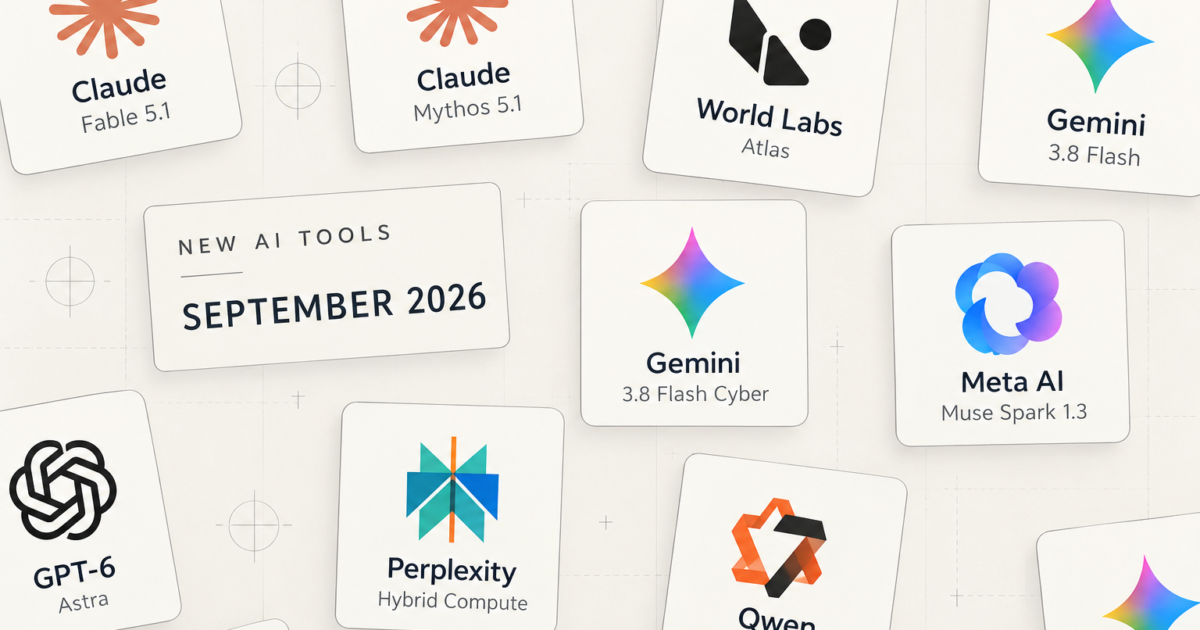
The new AI tools released September 2026 so far make this one of the busiest opening weeks the industry has seen all year. In just the first three days of the month, five major labs shipped new models, and the pace hasn’t slowed since. If you’ve been trying to keep up, here’s a clean rundown of everything that’s actually launched, what each one does, and why it matters.
Claude Fable 5.1 and Claude Mythos 5.1 (Anthropic, September 1)
Anthropic kicked the month off by shipping two new models at once. Claude Fable 5.1 is positioned as the new flagship for coding and knowledge work, and it topped the BenchLM leaderboard on launch day, ahead of both Claude Fable 5 and Claude Opus 5. Claude Mythos 5.1 sits above it as Anthropic’s higher tier release. Both models shipped with doubled science benchmark scores and a new anti-distillation safeguard built in, and pricing held steady at $10 per million input tokens despite the added capability.
Link: https://www.anthropic.com/news/fable-mythos-access
World Labs Atlas (September 1)
Also launching September 1, World Labs introduced Atlas, described as the first multimodal omni world model built for spatial intelligence. Rather than generating text or images, Atlas is built to understand and generate 3D space, and early reactions have already drawn comparisons to other spatial AI projects in the robotics and 3D modeling space. Access is currently available on request, and it’s shaping up to be one of the releases most likely to influence how 3D and robotics workflows get built going forward.
Link: https://www.worldlabs.ai
Gemini 3.8 Flash and Gemini 3.8 Flash Cyber (Google DeepMind, September 2)
Google DeepMind followed a day later with Gemini 3.8 Flash, its newest fast model, priced the same as its predecessor. The more notable release sitting alongside it is Gemini 3.8 Flash Cyber, which is being called the first dedicated cyber defense model shipped as a standalone product by a major AI lab. It’s aimed at governments and enterprises that need proactive threat detection built directly into their security workflows, and access is gated rather than open to everyone.
Link: https://deepmind.google
Muse Spark 1.3 (Meta, September 2)
Meta rounded out the September 2 releases with Muse Spark 1.3, which introduced a new contributor tier alongside the model itself. Details are still emerging on the full feature set, but the contributor tier signals Meta is experimenting with more community driven involvement in how the model develops going forward.
Link: https://ai.meta.com
Qwen3.8 27B (September 2)
Qwen also shipped Qwen3.8 27B the same day, adding another open weight option into an already crowded field of mid sized models. It was added to major model aggregators within hours of release, reflecting how quickly the open model ecosystem has been moving this year.
Link: https://qwenlm.github.io
GPT-6 Astra (OpenAI, September 3)
OpenAI closed out the opening week with GPT-6 Astra, its most capable broadly deployed model yet. Astra is the first OpenAI model to reach the “Critical” level of cybersecurity capability under the company’s own Preparedness Framework, a milestone that came with extra safety review before release, according to OpenAI’s official release notes. Alongside the model, OpenAI also launched Daybreak for Frontline Defenders, a new initiative backed by a $1 billion commitment to help defenders in critical infrastructure and government use frontier AI capabilities responsibly.
Link: https://openai.com
Perplexity’s Hybrid Compute (September 1)
Perplexity also joined the wave on September 1 with Hybrid Compute, a new setup that pairs cloud based answering with a local model, PPLX Qwen 3.8 27B, running on device. The pitch here is speed and privacy for certain queries, without giving up Perplexity’s broader search capabilities for anything more complex.
Link: https://www.perplexity.ai
Why This Wave of New AI Tools Matters
Looking at the new AI tools released September 2026 as a group, a pattern shows up fast. Nearly every major lab shipped something in the same 72 hour window, and a good chunk of these releases lean specifically into cybersecurity and defense, from Gemini’s Cyber variant to GPT-6 Astra’s Critical level classification to OpenAI’s Daybreak initiative. That’s not a coincidence. As models get more capable, the labs building them are having to invest just as heavily in the safeguards around them, not just the raw capability itself.
It’s also worth noting that several of these tools, like Atlas and Gemini 3.8 Flash Cyber, are launching through request based or gated access rather than opening to the public immediately, a sign that some of this September wave is being rolled out more carefully than a typical consumer product launch.
What to Expect for the Rest of September
Based on the pace of the first week alone, more releases are likely before the month closes out. We’ll keep this roundup of new AI tools released September 2026 updated as additional launches get confirmed.
If you want a deeper look at how two of this month’s biggest releases actually compare, we broke down the numbers in our GPT-6 Astra vs Claude Fable 5.1 comparison.

1 Thought
Steve Page
[…] For more on the frontier models at the center of this debate, check out our earlier coverage of new AI tools released in September 2026. […]