A concept car built out of an ordinary hatchback’s parts bin just drove nearly 800 miles on a single charge and rolled into Vienna with range to spare. The Volkswagen Mission Efficiency isn’t a flashy hypercar or a limited-run halo vehicle, it’s proof of what obsessive efficiency engineering can squeeze out of everyday EV components, and it just set three official world records doing it.
Three Records, Independently Verified
Volkswagen had the Mission Efficiency certified by Germany’s Record Institute, RID, in the category of near-production, everyday-use four-seat electric vehicles. The three records:
- Most aerodynamic road-legal car ever built, with a drag coefficient of just 0.158Cd, beating even the legendary Volkswagen XL1’s 0.186Cd and GM’s famous EV1
- Lowest energy consumption in an “ideal trip” test, using just 6.48 kWh per 100 km under controlled conditions, constant speed, no hills, accessories switched off
- Most economical near-production electric vehicle, proven through a real-world, documented long-distance drive
The Drive That Proved It
To back up the claims with something more convincing than a lab result, Volkswagen sent the prototype on a 1,278-kilometer (794-mile) journey from its main plant in Wolfsburg, through Poznań and Olomouc, and on to Vienna. The car stopped to charge only once during the entire trip. It briefly hit a top speed of 86 mph along the way, averaged around 42 mph overall, and still arrived in Vienna with 164 kilometers, roughly 102 miles, of range still showing on the dash. Real-world energy consumption for the trip, including charging losses, came in at 7.51 kWh per 100 km.
Built From an Ordinary Car’s Parts
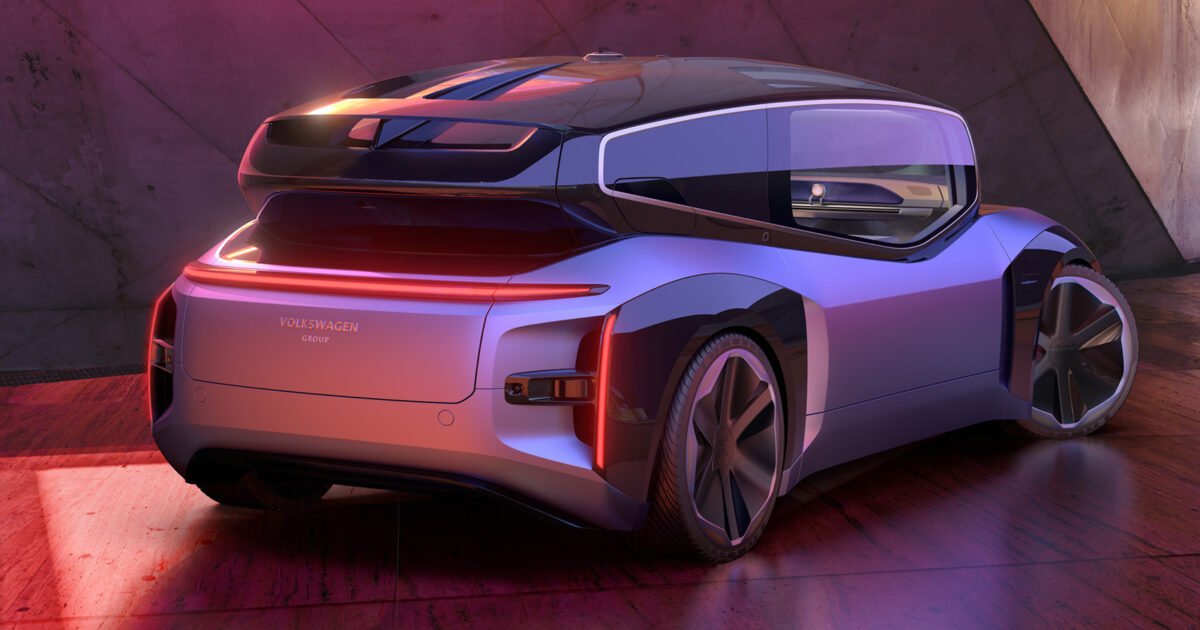
What makes the numbers genuinely striking is what the Mission Efficiency is built from. Underneath the sleek, teardrop-shaped body sits the same MEB+ platform, motor, and 54.9 kWh battery used in Volkswagen’s new ID. Polo, a small, affordable urban hatchback, not an exotic, purpose-built efficiency machine. VW essentially took an ordinary EV drivetrain and asked how far pure aerodynamic and engineering discipline alone could stretch it.
The car achieves its record-setting drag figure through a long list of small, deliberate choices, frameless windows, door handles flush-mounted into the body, active radiator shutters that close when cooling isn’t needed, and fully enclosed rear wheel covers with patented internal deflectors that Volkswagen says smooth airflow around the wheels themselves. Above roughly 50 mph, the payoff becomes dramatic, consumption runs more than 30% lower than a standard ID. Polo, and at 87 mph the Mission Efficiency uses roughly the same energy the standard ID. Polo needs at just 62 mph.
A Solar Roof That Actually Contributes
A 370-watt solar array runs across the roof and down the rear hatch, feeding the car’s onboard electrical systems directly rather than the high-voltage battery. Under good sunlight, Volkswagen says that solar system alone can add up to 30 km, about 18 miles, of driving range per day, a small but genuinely free efficiency bonus stacked on top of the aerodynamic gains.
A Deliberate Nod to an Old Favorite
Volkswagen isn’t shy about where the inspiration came from. The Mission Efficiency is widely being described, including by VW’s own chief designer Andreas Mindt, as a spiritual successor to the Volkswagen XL1, the plug-in hybrid efficiency icon Volkswagen introduced back in 2013, which held the title of the world’s most economical production car at the time. Where the XL1 relied on a tiny diesel-hybrid setup to hit its numbers, the Mission Efficiency proves a similar philosophy can now be achieved with a fully electric, mainstream-platform drivetrain.
Not for Sale, But Not Just a Show Car Either
Volkswagen has been clear that the Mission Efficiency is a concept vehicle, not a production car, and it isn’t coming to showrooms as-is. But it’s also not purely a design exercise. VW describes it as a rolling testbed, built specifically to evaluate technologies and design choices that are expected to influence future production Volkswagen EVs, meaning pieces of what’s on display here, the wheel covers, the active aero, the flush handles, could plausibly show up on real, buyable Volkswagens down the line.
The Bottom Line
At a moment when a lot of EV headlines are chasing bigger batteries and faster charging as the answer to range anxiety, the Volkswagen Mission Efficiency makes a quieter, arguably more interesting case, that raw efficiency engineering, squeezed out of parts that already exist in an affordable production car, can get you most of the way there without a bigger battery at all. Whether any of this actually reaches production Volkswagens remains to be seen, but as a proof of concept, it’s hard to argue with 794 miles on one charge.
You can see the full reveal and technical breakdown directly on Volkswagen’s official newsroom.
For more on how the EV world is evolving this year, check out our coverage of the Tesla Model Y’s record-breaking global sales streak.