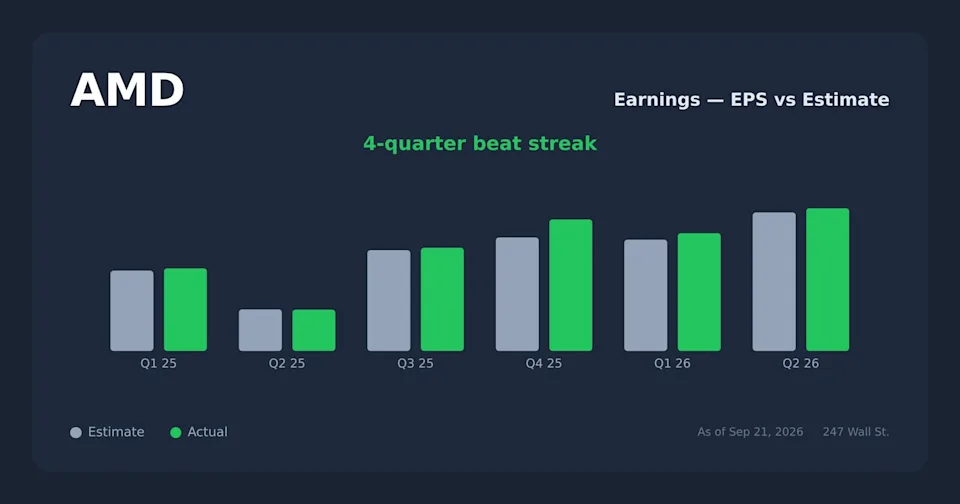
A decade ago, AMD stock traded in single digits. On Monday, September 21, it crossed $1 trillion in market capitalization for the first time in the company’s history, surging as much as 9.6% in a single session to become the fourth American chipmaker to reach that valuation tier, following Nvidia, Broadcom, and Micron.
The Numbers Behind the Milestone
AMD shares touched an intraday high of $615.52, capping a five-day winning streak in which the stock climbed roughly 24-25%. Zoom out further and the picture gets even more dramatic, AMD stock is up approximately 171-185% for 2026 alone, dramatically outpacing the Nasdaq’s roughly 15.8% gain over the same period. According to figures circulating alongside the milestone, $10,000 invested in AMD back in 2016 would be worth roughly $3.05 million today, a return of more than 30,000%.
Even at $1 trillion, AMD remains well behind Nvidia’s roughly $5.4 trillion market cap, meaning AMD is worth about a fifth of its closest rival despite the milestone.
What’s Actually Driving the Rally
A few concrete factors are converging here rather than pure market enthusiasm alone:
- Data center revenue growth: AMD’s data center segment revenue rose 107% year over year to $6.7 billion in its most recent quarterly report
- A specific, named customer commitment: Anthropic locking in 2 gigawatts of AMD’s MI450 GPUs has directly anchored CEO Lisa Su’s forecast that data center revenue could more than double in 2027
- Pricing power: AMD has pushed through roughly 10% price increases across its AI accelerator and consumer GPU lineup
- A massive market-size bet: AMD’s CFO has projected the total addressable AI silicon market could reach $2 trillion to $3 trillion by 2030, a figure competitors and analysts are increasingly using as the reference point for sizing the entire industry
- A broader semiconductor rally: The same session saw Arm Holdings and Intel each rise roughly 10% too, driven partly by Meta’s new Muse AI agent briefly claiming the top spot among free downloads on Apple’s App Store, a sign the rally extended well beyond AMD alone
The Uncomfortable Math Underneath the Rally
Here’s the tension worth sitting with. AMD currently holds an estimated 13% share of the AI accelerator market, compared to Nvidia’s roughly 81%, according to IDC figures. Nvidia’s data center revenue alone ran $75.2 billion in a single recent quarter, compared to AMD’s entire company revenue of $11.5 billion over the same period. In other words, the market isn’t pricing AMD at $1 trillion based on where its current business actually sits today, it’s pricing in AMD closing a substantial share gap with Nvidia over the next several years. Analysts project AMD could reach 20-25% AI accelerator market share by late 2026, up from roughly 13% earlier in the year, but that’s still a projection, not a delivered result.
Valuation researchers at GuruFocus have flagged the stock as roughly 115% overvalued relative to their calculated fair value, and AMD’s trailing price-to-earnings ratio of about 156.6 sits well above its five-year historical median of roughly 102. Not every analyst agrees on how much of a red flag that actually is, opinions genuinely differ on whether AMD’s current price reflects justified optimism about future AI accelerator share gains or a rally that’s outrun the fundamentals.
Why This Milestone Matters Beyond AMD Itself
AMD becoming the fourth US chipmaker to cross $1 trillion is also a pointed marker for its closest rival, Intel, whose market cap sits around $648 billion, roughly $352 billion below AMD’s new valuation, meaning AMD is now worth about 1.5 times as much as Intel despite Intel’s much longer history at the top of the semiconductor industry. That gap is likely to put renewed pressure on Intel to show concrete progress on its own AI accelerator and foundry roadmap, or risk the valuation gap widening even further.
The milestone also lands at a notably symbolic moment, arriving the same week as a planned Trump-Xi summit, adding a geopolitical backdrop to a rally that’s fundamentally about who controls the infrastructure powering the global AI buildout.
The Bottom Line
AMD crossing $1 trillion is a genuinely significant milestone, but the honest read is that it’s a bet on the future more than a reflection of AMD’s current market position. Whether that bet pays off depends almost entirely on whether AMD can actually convert its pipeline of customer commitments, Anthropic’s GPU deal chief among them, into real, delivered market share against a competitor that still commands more than six times AMD’s slice of the AI accelerator business today.
You can track AMD’s latest financial results directly on AMD’s official investor relations site.
For more on how AI infrastructure spending is reshaping the chip industry, check out our coverage of Oracle’s AI cloud revenue growth and mounting debt.


1 Thought
Steve Page
[…] more on the AI chip race driving this, read our coverage of AMD crossing $1 trillion and Qualcomm’s AI-first Hexagon […]